Monday, June 29, 2015

Saintly Commentary on Love

Come unto to me, all that labor and are heavy laden, and I will give you rest - Matthew 11:28

In Matthew 11:28, the Lord teaches that we will have rest by following Him. But to what ends do we follow Him? To Augustine, we follow to obtain “the sight of God,” where we “rejoice in perpetual rest,” according to the teaching of Chrysostom.

Thus, by following Him, we can ascend to the sight of God, where we rejoice in perpetual rest. This promised spiritual reward is indescribable in its sublimity, and is conceivable perhaps only to those Saints who have obtained that reward.  But how do we follow Him? What interior transformation must occur before we are able to make progress down this marvelous road?

Love, and only love, is how we prepare our souls to be ready to follow Him. Of course, first, we must ask what kind of love leads us to this heavenly reward. We must be precise as possible so that we are not led astray.  Augustine now reveals the teaching:

And now He teaches them how to fit themselves to follow Him: “
A new commandment I give you, that you love one another.” But does not the old law say, you shall love your neighbor as yourself (Lev., 19:18)? Why then does He call it a new commandment?

The answer, as Augustine points out, is the phrase, as I have loved you. But how did He love his disciples?

...but it is the love which our Lord distinguishes from the carnal affection. Not the love with which men love one another, but that of the children of the Most High God, who would be brethren of His only-begotten Son.

What type of love is distinguished from the carnal affection? What is the love of the children of the Most High God? Augustine:

What did He, in loving us, love, but God in us; not who was in us, but so that he might be?

To seek the sight of God and have perpetual and eternal rest, we must follow the Lord. We are not ready to follow the Lord until we love one another as the Lord loved his disciples. That love is the love of God's presence in one another; rather, that love is a desire that each of us knows God by becoming a dwelling place of God.


UPDATE: 7/3/2015

The saintly teachings on love are numerous, and to collect them all is a monumental task. However, I feel that I need to mention some of teachings of St. Aquinas in his commentary on Romans:

He  [the Apostle Paul] says let love be without dissimulation, so that it consist not in word or outward appearance but in genuine affection of heart and in efficacious works. 

Second, he teaches that love should be pure when says: "hating evil." Love is pure when a person does not consent to his friend  in evil, but so loves him that he hates his vices. 

Third, he teaches that love should be honorable when he says: "cleaving to the good," so that one adheres to another because of his virtuous goodness...


Wednesday, June 24, 2015

St. Augustine on Christian Judgement: "Judge not."

The below quotes represent some of Augustine's meditations on Matthew 7:1-5. In his interpretation, Augustine conveys in simple language the majesty of the Lord's teaching:  we are all sinners; we succumb to pride and vanity; we rarely have all the information necessary to form a correct judgement; and we judge to serve ourselves, not the Lord and our neighbor.
______________________

On how to reason when tempted to find fault with another

When then we are brought under the necessity of finding fault with any, let us first consider whether the sin be such as we have never had; secondly that we are yet men, and may fall into it; then, whether it be one that we have had, and are now without, and then let our common frailty come into our mind, that pity and not hate may go before correction. Should we find ourselves in the same fault, let us not reprove, but groan with the offender, and invite him to struggle with us. Seldom indeed and in cases of great necessity is reproof to be employed; and then only that the Lord may be served and not ourselves.

On the common faults of those who judge

The Lord having admonished us concerning hasty and unjust judgments; and because that they are most given to rash judgment, who judge concerning things uncertain; and they most readily find fault, who love rather to speak evil and condemn than to cure and correct; a fault that spring either from pride or jealousy - therefore He subjoins, "Why seest though the mote in thy brother's eye, and seest not the beam in thy own eye?" 

On judgement with uncertainty

1)  I suppose the command here to be no other than that we should always put the best interpretation on such actions as seem doubtful with what mind they were done. But concerning such as cannot be done with good purpose, as adulteries, blasphemies, and the like, He permits us to judge; but of indifferent actions which admit of being done with either good or bad purpose, it is rash to judge, but especially to condemn. 

2)  There are two cases in which we should be particularly on our guard against hasty judgments, when it does not appear with what mind the action was done; and when it does not yet appear, what sort of man any one may turn out, who now seems either good or bad. Wherefore he should neither blame those things of which we know with what mind they are done, nor so blame those things which are manifest, as though we despaired of recovery. 

____________________


Sunday, June 21, 2015

The Mysticism of Laudato si

Below, I present a few of the passages from Laudato si that concern truth, beauty, aesthetics, and the mystical and contemplative Christian path. Each passage is highly instructive for contemplatives and all prayerful Christians.  Select passages, given their focus on artistic and natural beauty enabling the ascent to God, are also teachings on beauty in the liturgy. Popular commentary has given less attention to the latter contribution of the encyclical--how  beauty in liturgical celebration, like natural beauty, takes us out of our selves and into a wider and deeper consciousness.

____________________________


Every creature is thus the object of the Father’s tenderness, who gives it its place in the world. Even the fleeting life of the least of beings is the object of his love, and in its few seconds of existence, God enfolds it with his affection. Saint Basil the Great described the Creator as “goodness without measure”, while Dante Alighieri spoke of “the love which moves the sun and the stars”. Consequently, we can ascend from created things “to the greatness of God and to his loving mercy”.


- from 77


Human beings, even if we postulate a process of evolution, also possess a uniqueness which cannot be fully explained by the evolution of other open systems. Each of us has his or her own personal identity and is capable of entering into dialogue with others and with God himself.


- from 81


Jesus lived in full harmony with creation, and others were amazed: “What sort of man is this, that even the winds and the sea obey him?” (Mt 8:27). His appearance was not that of an ascetic set apart from the world, nor of an enemy to the pleasant things of life. Of himself he said: “The Son of Man came eating and drinking and they say, ‘Look, a glutton and a drunkard!’” (Mt 11:19). He was far removed from philosophies which despised the body, matter and the things of the world. Such unhealthy dualisms, nonetheless, left a mark on certain Christian thinkers in the course of history and disfigured the Gospel.


- from 98


The New Testament does not only tell us of the earthly Jesus and his tangible and loving relationship with the world. It also shows him risen and glorious, present throughout creation by his universal Lordship: “For in him all the fullness of God was pleased to dwell, and through him to reconcile to himself all things, whether on earth or in heaven, making peace by the blood of his cross” (Col 1:19-20). This leads us to direct our gaze to the end of time, when the Son will deliver all things to the Father, so that “God may be everything to every one” (1 Cor 15:28). Thus, the creatures of this world no longer appear to us under merely natural guise because the risen One is mysteriously holding them to himself and directing them towards fullness as their end. The very flowers of the field and the birds which his human eyes contemplated and admired are now imbued with his radiant presence.


- from 100


By learning to see and appreciate beauty, we learn to reject self-interested pragmatism. If someone has not learned to stop and admire something beautiful, we should not be surprised if he or she treats everything as an object to be used and abused without scruple.


- from 215


The universe unfolds in God, who fills it completely. Hence, there is a mystical meaning to be found in a leaf, in a mountain trail, in a dewdrop, in a poor person’s face. The ideal is not only to pass from the exterior to the interior to discover the action of God in the soul, but also to discover God in all things. Saint Bonaventure teaches us that “contemplation deepens the more we feel the working of God’s grace within our hearts, and the better we learn to encounter God in creatures outside ourselves”.


- from 233


Saint John of the Cross taught that all the goodness present in the realities and experiences of this world “is present in God eminently and infinitely, or more properly, in each of these sublime realities is God”. This is not because the finite things of this world are really divine, but because the mystic experiences the intimate connection between God and all beings, and thus feels that “all things are God”.


- from 234

Encountering God does not mean fleeing from this world or turning our back on nature. This is especially clear in the spirituality of the Christian East. “Beauty, which in the East is one of the best loved names expressing the divine harmony and the model of humanity transfigured, appears everywhere: in the shape of a church, in the sounds, in the colours, in the lights, in the scents”. For Christians, all the creatures of the material universe find their true meaning in the incarnate Word, for the Son of God has incorporated in his person part of the material world, planting in it a seed of definitive transformation. “Christianity does not reject matter. Rather, bodiliness is considered in all its value in the liturgical act, whereby the human body is disclosed in its inner nature as a temple of the Holy Spirit and is united with the Lord Jesus, who himself took a body for the world’s salvation”.


- from 235


It is in the Eucharist that all that has been created finds its greatest exaltation. Grace, which tends to manifest itself tangibly, found unsurpassable expression when God himself became man and gave himself as food for his creatures. The Lord, in the culmination of the mystery of the Incarnation, chose to reach our intimate depths through a fragment of matter. He comes not from above, but from within, he comes that we might find him in this world of ours.


- from 236


Thursday, June 18, 2015

Holy Mass, Liturgy, and Holy Scripture

The month of June, 2015, brought us the beautiful Sacra Liturgia conference in New York City, and will bring us the June 30th resignation of John Romeri, Director of the Office for Liturgical Music in the Archdiocese of Philadelphia. These two events provide, on one side, a vision of the Church aimed toward lifting souls to God, and, on the other side, a vision that seems to place accessibility rather than transcendence as the primary value in liturgy.

In the wake of Mr. Romeri's announced resignation, some online commentary has brought up the distinction between a liturgy directed toward God and a liturgy directed toward the congregation. Beauty is more associated with the former, since beauty in forms is used to impart to the fallible and weak human understanding the unseen beauty of the divine. A banal liturgy is associated with the latter, since the music, forms, and prayers are not conducted to enable self transcendence according to the guidance of Saints, but to achieve whatever ends the majority of a particular congregation prefers.

Many religious men and women have written eloquently on beauty and the liturgy.  Even our missals provide guidance, as in the 1962 Roman Missal, p 131, of the 6th edition from Baronius Press. I see fewer authors in the online community appeal to Holy Scripture (of course there are exeptions). In this post, I want to highlight Matthew 6:5-6:

And when thou prayest, thou shalt not be as the hypocrites are; for they love to pray standing in the synagogues and in the corners of the streets, that they may be seen of men. Verily I say unto you, They have their reward. 

But thou, when thou prayest, enter into thy closet, and when thou hast shut thy door, pray to thy Father which is in secret; and thy Father which seeth in secret shall reward thee openly. 

This passage is related to the liturgy of the Holy Mass in the following way. The passage is about prayer, and [t]he Holy Mass is a prayer in itself, even the highest prayer that exists (1962 Roman Missal, page 897).  The passage is also not singularly focused on private, secluded prayer, according to the interpretation of Pseudo-Chrysostom: But I suppose that it is not the place that the Lord here refers to, but the motive of him that prays; for it is praiseworthy to pray in the congregations of the faithful. 

With this passage of Holy Scripture in mind, let us begin to consider its relevance to the liturgy. Much can be said on this topic, but commentary by Pseudo-Chrysostom provides a useful starting point to raise questions for discussion.

"Solomon says, 'Before prayer, prepare thy soul.'"

How can we use the time before Holy Mass to prepare our souls for prayer?  This includes the entire morning of Mass, and the time at church before Mass begins. (See my post on meditation before Mass.)

"Prayer is as it were a spiritual tribute which the soul offers of its own bowels. Wherefore the more glorious it is, the more watchfully ought we to guard that it is not made vile by being done to be seen of men."

What type of liturgy would most closely represent a "spiritual tribute which the soul offers of its own bowels?" What type of liturgy helps transcend the physical eye toward spiritual vision with our inner eye?

"But I suppose that it is not the place that the Lord here refers to, but the motive of him that prays...Whoever then so prays to be seen of men does not look to God but to man, and so far as his purpose is concerned he prays in the synagogue. But he, whose mind in prayer is wholly fixed on God, though he pray in the synagogue, yet seems to pray with himself in secret."

What liturgy most effectively helps us look to God, not to man? What liturgy inspires a prayer so devout and deep that the mind is wholly fixed on God? That last sentence deserves special consideration, as a mind wholly fixed on God is an extraordinary feat of meditation and contemplation. 

Wednesday, June 17, 2015

The Bach Well-Tempered Clavier Meditation

What is a Fugue?


The Fugue is the most complex polyphonic musical form, involving imitation among the parts (called “voices” whether they are vocal or instrumental). The word fugue comes from fuga, meaning to chase since each voice “chases” the previous one.

Alan Warburton recently created a stunning CGI visualization of the Prelude and Fugue in C from Bach's Well-Tempered Clavier (WTC) BWV 846. I first saw the visualization on Classic FM and then at the
Creator's Project blog.  The visualization powerfully contrasts the relative simplicity of the prelude to the complexity of the 4-voice fugue. It highlights the complexity of the fugue better than other computer-based visualizations, in my opinion, because the fugue is visualized in three dimensions. All four voices are clearly distinguished.

Considering my earlier post about the mystical experience in Bach's music, I began to think about how listening to fugues affects our minds. In particular, I conjecture that meditation on fugues can be a powerful exercise of concentration and mental visualization that leads to higher states of awareness.  To investigate this conjecture, I use a wearable EEG to assess whether preludes can calm the mind and whether fugues can focus the mind.

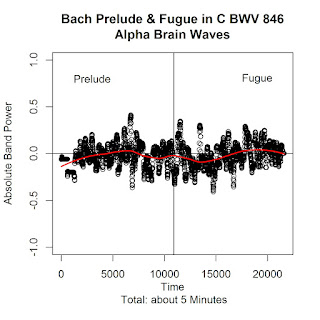
Below, watch as the mellow and sweet prelude changes to the complex fugue for 4 voices. The brain waves show markedly different patterns across the two musical movements. During the prelude, there is suggestive evidence of a very relaxed state of mind, with  high alpha waves and decreasing beta and gamma waves. Once the fugue begins, however, the beta and gamma waves shoot up at a steady pace. The alpha, theta, and delta waves remain roughly constant. Together, these patterns suggest that focus is increasing while calm awareness is maintained. Please note that I use the word "suggest" since the analysis of EEG brain waves is very complex, and my cursory reading of online popular writings offers only general ideas about alpha, beta, theta, delta, and gamma waves.  However, subjectively, I can confirm that I felt calm and then focused and aware.

A good summary of brain activity and meditation is here from Bryan Williams, but I cannot vouch for its accuracy. It includes interesting findings from research on contemplative nuns, but the summary is more general:

There are five types of brain waves that are distinguished by their frequency, measured in cycles per second, or Hertz (Hz): Delta waves (1 – 3 Hz) have the slowest wave cycles, and commonly appear when we are in a deep sleep. Theta waves (4 – 7 Hz) can also be present during sleep, usually when we start to feel drowsy and fall into a light sleep (Carlson, 1992, pp. 242 – 243). Alpha waves (8 – 12 Hz) are typically present during a state of relaxed awareness, when our minds are not actively engaged in deep thought. Beta waves (13 – 29 Hz) appear when we are actively thinking, alert, and attentive (Schneider & Tarshis, 1995, pp. 412 – 413). Gamma waves (30 – 80 Hz) have the fastest wave cycles, and often arise when we are mentally integrating and processing complex sensory information (Desmedt & Tomberg, 1994; Joliot et al., 1994).

Perhaps a new meditation exercise can be the Bach WTC Meditation: an intense period of meditation on every prelude and fugue in the WTC Book 1 or 2. You train your mind to relax during the preludes, and focus and visualize during the fugues. I suspect that you would reach a powerful mental state by the end of the recording. Once you reach the level of master, you progress to the Art of the Fugue.

______________________________

The Well-Tempered Clavier

Beta waves (13 – 29 Hz) appear when we are actively thinking, alert, and attentive (Schneider & Tarshis, 1995, pp. 412 – 413).


Gamma waves (30 – 80 Hz) have the fastest wave cycles, and often arise when we are mentally integrating and processing complex sensory information (Desmedt & Tomberg, 1994; Joliot et al., 1994).


Alpha waves (8 – 12 Hz) are typically present during a state of relaxed awareness, when our minds are not actively engaged in deep thought. 


Theta waves (4 – 7 Hz) can also be present during sleep, usually when we start to feel drowsy and fall into a light sleep (Carlson, 1992, pp. 242 – 243).


Delta waves (1 – 3 Hz) have the slowest wave cycles, and commonly appear when we are in a deep sleep. 


Watch the entire video here.


UPDATE 6/21/2015

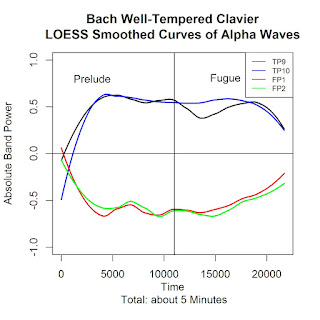
Most of the changed activity is in the frontal lobes of the brain. In the figures below, the lines with "TP" represent the EEG sensors at the temporal poles by the ears, while the "FP" lines represent the sensors at the front of the head. Prelude is left half (1 - 11000) on the x-axis, and the Fugue is the right half (11001 - end).


Monday, June 15, 2015

Bach, Mozart, and a Brain Wave Illustration

This post was motivated by Zelter and Geothe's reflections on the mystical power of Bach's organ music.  Select quotes are presented below. Personally, I believe careful attention to Bach's music can help us ascend to an advanced mystical state of consciousness. Why do I feel this way? His music contains at the same time extraordinary musical complexity and extraordinary beauty. To the average listener, it can seem both simple and complex at the exact same moment. At a minimum, I believe it helps one to begin to understand why mathematical equations can be beautiful.

I sense that this music can help us approach the level of contemplation taught by Diotima to the disciple Socrates in the Symposium:

...and after laws and institutions he will go on to the sciences, that he may see their beauty, being not like a servant in love with the beauty of one youth or man or institution, himself a slave mean and narrow-minded, but drawing towards and contemplating the vast sea of beauty, he will create many fair and noble thoughts and notions in boundless love of wisdom.

In our mystical ascent, we progress up to contemplate the beauty of the sciences and knowledge, of which I think mathematical equations are a part. What, then, makes mathematical equations beautiful? Not this one or that one, but them all? Perhaps Bach is leading us to this realization captured in Diotima's teaching.

These mystical heights are not achieved in the EEG results below. Lying on my living room floor, tired after a long day, we were in no mental state to achieve spiritual greatness. Rather, they are a simple and preliminary illustration of how Bach and Mozart can influence the brain.

The Bach results are from the Muse wearable on my head. I am 33 years old and have meditated quite seriously for about 6 years. Providing a different perspective, my fiancee also wore the Muse while listening to her favorite piece of music--Mozart's Et Incarnatus Est as performed by Barbara Bonney under the direction of Sir John Eliot Gardiner. She is mid-twenties and has trained in voice and violin since a young child. She brings a wealth of musical knowledge to her experience listening to the music.  She writes:

...usually when I practice, I get into an intense trance-like mode of concentration and I felt the same way listening to the recording. I think more than just enjoying the piece as a listener, I was also singing along to the soprano line in my head, preparing breaths in the necessary spots, lifting my palate and imagining singing along with some of the high sustained notes, etc.

I, on the other hand, have no musical training, and can barely hum a string of quarter notes.

We begin.  Videos first, then time-series plots of the entire session.
_____________________________

Bach

It is only since Mozart's time, that there has arisen a greater inclination to understand Sebastian Bach, for the latter appears thoroughly mystic, just where the former impresses us clearly from without....

-- Letter from Zelter to Johann Wolfgang von Goethe

[W]hen my mind was in a state of perfect composure, and free from external distraction, that I first obtained some idea of your Grand Master (Sebastian Bach). I said to myself, it is as if the eternal harmony were conversing with itself, as it may have done, in the bosom of God, just before the Creation of the world. So likewise did it move in my inmost soul, and it seemed as if I neither possessed nor needed ears, nor any other sense--least of all the eyes

-- Letter from Johann Wolfgang von Goethe to Zelter, on the organist Berka playing Bach.

The organ is Bach's own peculiar soul, into which he breathes immediately the living breath. His theme is the feeling just born, which, like the spark from the stone, invariable springs forth, from the first chance pressure of the foot upon the pedals. Thus by degrees he warms to his subject, till he has isolated himself, and feels alone, and then an inexhaustible stream passes out into the infinite ocean...Weighing every possible testimony against him...[Bach] is one of God's phenomena. 

-- Letter from Zelter to Johann Wolfgang von Goethe

EEG Illustrations
____________________


Brain waves while listening to the Bach Prelude for Organ in E-Flat Major BWV 552. Eyes are closed. The artist is Helmut Walcha. The recording is Walcha's Bach: Great Organ Works, from DG.

Subject: Male, 33 years old. 6 years of meditation experience.

Brain waves start with high alpha wave dominance. Later, the brain waves begin a pattern of Beta and Gamma dominance. Patterns really start to change at about the 4:00 minutes mark. By the end of the piece, Beta waves are the highest.


__________________________________

Mozart

EEG Illustrations
____________________

An example of music leading one into deep, focused concentration.

Brain waves while listening to the Mozart's Et Incarnatus Est. The recording is from You Tube and features Barbara Bonney.  Eyes are closed.

Subject: Female, mid twenties, who has trained as a classical musician (violin and voice) since a young child and performs regularly today. 

Brain waves start with high alpha wave dominance. Later, the brain waves begin a pattern of Beta and Gamma dominance. Patterns really start to change at about the 2:00 minutes mark: beta and gamma soar.  By about the 4:20 mark, beta and gamma are clearly dominant and remain so until the end. Noe: the EEG loses signal strength at several points in this recording. 


_______________________________
Citations
1) Coleridge, A.D. (1892). Geothe, Letters to Zelter.  London:  George Bell & Sons. Accessed via Google Book's Free Ebooks.

Sunday, June 14, 2015

Meditation before Holy Mass with Beta/Gamma Waves


A serious morning meditation is always a good way to prepare one' s mind for the great Holy Mass. These meditations can include the Rosary, contemplative prayer, or any tradition that best suits one's personal practice. The benefits include far less distraction and greater interior participation in the mystery.

The soul aspires after heaven, rejoicing in the meantime in being in the communion of God's Church upon earth. - 1962 Roman Missal

Today's meditation was a strong session. Lately, I have used my Muse a few times per week just to gauge what is happening inside my brain during meditation. An unexpected benefit of the Muse is that is improves my focus in meditation just because I know it's there. In other words, I know my mind is being monitored, and any distraction is instantly detected. Imagine if one could wear one of these tools at Mass (which I would never recommend), or even during a zazen practice, where the teacher could see inside of you to detect a lazy mind!

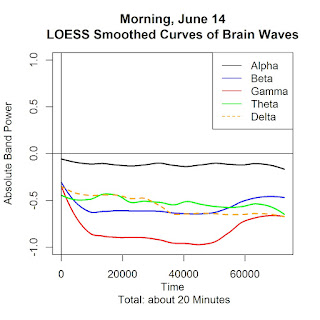
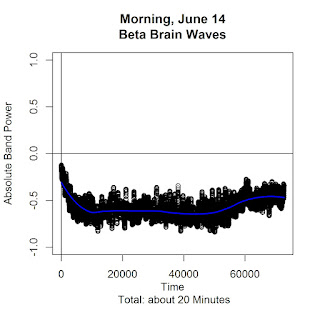
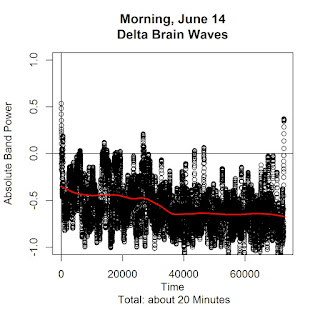
I post today's figures only because I note a different brain wave pattern than usual. Towards the end of my meditation, when I was in a state of  quite powerful focus and interior energy, together with a near empty mind, the EEG shows a spike in Beta/Gamma waves. I understand how difficult it is to draw any firm conclusions from these results; however, it is a pattern worth noting.